
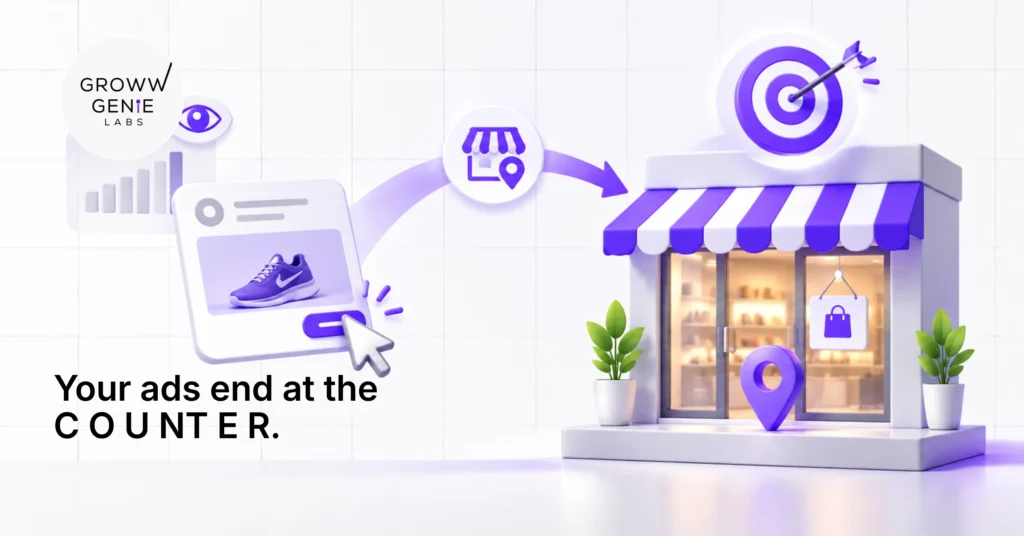
In short: If your business makes money when people walk through the door, reach is the wrong goal for your ads. Set targets around walk-ins, enquiries and sales in the store, track the path from ad to counter with simple tools, and judge every campaign by footfall, not views.
What is a store-visit goal? A store-visit goal measures an ad campaign by the people it brings into a physical location, and what they buy there, rather than by how many people saw the ad online.
The report says your ad reached 1.2 lakh people. The impressions are up, the engagement looks healthy, and the cost per click is lower than last month.
Then Saturday comes, and the store looks exactly like it did the Saturday before.
If you run a showroom, a store, a clinic or a restaurant, this gap is familiar. Most store visit ads are still measured on a screen. Your business is measured at the counter. Until those two are connected, you’re paying for one and hoping for the other.
01 — Why is reach the wrong goal for an offline business?
Because reach counts screens, not footsteps. A campaign can reach thousands of people who will never visit, and the report will still call it a success.
Ad platforms optimise for whatever you ask them for. Ask for reach and they find the cheapest eyeballs available, which are rarely the people who live ten minutes from your store and are ready to buy this month.
Reach also hides the real question. For an offline business, the only numbers that matter are these: how many people came in, what they bought, and what it cost to bring each of them. A big reach number with an unchanged store is not a result. It’s an expense with a nice chart.
That doesn’t make awareness useless. It just means awareness is a step, not the goal.
02 — What should an offline business measure instead?
The steps between seeing an ad and buying in the store. Think of it as a ladder, and measure every rung.
- Seen. Reach and frequency in the area your customers actually travel from.
- Asked. Calls, WhatsApp messages, direction requests and enquiries about the product you advertised.
- Visited. Walk-ins, ideally the ones you can trace to the campaign.
- Bought. Sales in the category you promoted, compared with the same period before.
- Returned. Repeat visits from the people who came in the first time.
The two numbers to watch most closely are cost per walk-in and sales in the promoted category. If those move, the campaign is working, whatever the reach says.
03 — How do you connect online ads to offline visits?
With simple, deliberate tracking set up before the campaign starts. You don’t need expensive software. You need a baseline and a way for every visitor to leave a trace.
- Start with a baseline. Count normal walk-ins for two to four weeks before the campaign. Without it, you can’t tell what the ads changed.
- Give the ad its own path. A WhatsApp click-to-chat link with a pre-filled message, or a dedicated phone number, shows exactly which enquiries came from the campaign.
- Use an “ask at the counter” offer. A code word or offer mentioned only in the ad tells staff who came because of it.
- Ask one question at billing. “How did you hear about us?” takes five seconds and builds your best data set.
- Watch your map listing. Calls and direction requests from your business profile on maps rise when local ads are working.
- Keep a daily tally. A simple sheet at the counter, filled in by staff, beats any estimate.
Some ad platforms can estimate store visits, but usually only for larger advertisers with enough data. Most single-location businesses get clearer answers from their own counter.
04 — How do you plan ads that bring people in?
Plan backwards from the visit. Decide who should come in, what will bring them now, and what happens when they arrive.
- Draw the radius around real customers. Target the neighbourhoods your customers actually travel from, not the whole city.
- Give a reason to come now. A launch, an event, a limited collection or a season. Avoid anything that feels like a stock clearance; it attracts bargain hunters and cheapens the brand.
- Lead with an easy first purchase. A lower-ticket product makes the first visit an easy decision, and the store does the rest.
- Show the store and the product in hand. People visit places they can picture.
- Make the next step one tap. Call, WhatsApp or directions, not a long form.
- Time it to buying moments. Before weekends, paydays and festivals, not in the middle of a quiet week.
- Prepare the store. Staff should know the offer, the stock should be ready, and the experience should match the ad. An ad can bring someone in once. The store decides whether they come back.
05 — How do you review store campaigns week by week?
Against targets agreed before the campaign started, once a week. Look at enquiries, walk-ins, cost per walk-in and category sales, then move budget towards the audiences, creatives and offers that produced visits.
One week of data is noisy. Three or four weeks shows a pattern. Keep the review short and the decisions clear: what to stop, what to scale and what to test next.
06 — Why do so many store campaigns stop at reach?
Because the gap between the ad and the counter belongs to nobody. Whoever runs the ads reports what the platform shows. The store team sees footfall but not the campaign. Nobody connects the two, so reach becomes the default measure of success.
Closing that gap is mostly a matter of ownership: agreeing the targets, setting up the tracking and reviewing both sides together every week. It’s simple work, but it needs someone who looks at the screen and the counter at the same time.
Before your next campaign, set these five numbers
- Your normal weekly walk-ins (the baseline).
- The walk-ins you want the campaign to add.
- The most you can pay for one walk-in.
- The product or category you’re promoting.
- How you’ll count visits that came from the ads.
If you can’t fill in all five, the campaign isn’t ready to launch.
Frequently asked questions
Is reach ever a useful goal for an offline business? Yes, as a first step. Reach builds local awareness, especially for a new store or category. But it should feed enquiries and visits, and be judged by them.
How much should one store visit cost? Work it out from your margins. Maximum cost per walk-in = average gross profit per sale × the share of walk-ins who buy. If a sale earns ₹2,000 and half of visitors buy, you can pay up to ₹1,000 per walk-in and still break even on the first visit.
Can Google or Meta track store visits for a small business? Sometimes, but store-visit measurement usually needs a large volume of data and isn’t available to every advertiser. A baseline, a campaign-specific WhatsApp link or number, and a question at billing work for any business.
How long before store ads show results? Enquiries often move within days. Walk-in and sales patterns need three to four weeks of comparison against your baseline.
Should offline businesses use WhatsApp in ads? Yes. A click-to-chat button with a pre-filled message is one of the easiest ways to start a conversation and trace it back to a campaign.
Your ads should be judged where your business is: at the door, not on the dashboard.
If your campaigns look busy online but your store doesn’t feel it, tell us about it. We’ll show you where the gap is. Share your growth wish →